





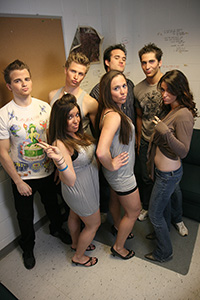
With only eight episodes, “Jersey Shore” has won the hearts of millions and pissed off even more. The depiction of eight Italian-American self-described “guidos” and “guidettes” has left Italian-American groups, New Jersey legislators and the town of Seaside Heights up in arms, but hasn’t prevented the show from becoming a pop-culture phenomenon.
The show quietly crept onto MTV’s lineup in early December, but gained tremendous momentum two episodes later, largely as a result of the now infamous “Snooki punch,” which quickly became a highly popular video on YouTube and spiked the show’s ratings.
Robert Thompson, founding director of the Bleier Center for Television and Popular Culture at Syracuse University and trustee professor of television and popular culture at the S.I. Newhouse School of Public Communications, explained that the immediacy of the Internet has furthered the popularity of the show with the ability to go online and watch past episodes easily.
“It’s the same principle of a viral video,” Thompson said. “You don’t have to wait for the episode to come on. In the pre-Internet era it took a lot longer for things to catch on — stuff spread on a weekly basis.”
But what exactly makes this show so irresistible? Thompson explained that the success of a reality TV show all boils down to one thing — casting.
“A good season of ‘The Real World’ versus a bad season of ‘The Real World’ all depends on casting,” Thompson explained. “With “Jersey Shore,” they just got a combination of people that are so comfortable of behaving so badly and it seems to come so naturally to them.”
The eight cast members brought the drama from the first episode, or more precisely, from the moment Nicole “Snooki” Polizzi walked through the door of the beach house and poured herself shots at three in the afternoon.
“They really managed to find a group of people that are so fun to watch,” Thompson said.
Ryan Vaughan, a Binghamton University professor who specializes in television and popular culture, explained that while people may enjoy this genre of television, it’s not actually real.
“Reality television is a misnomer,” Vaughan explained. “Even if it isn’t directly scripted, editing is enough to manipulate the show. If you look at the first episode of ‘The Real World,’ it’s actually really boring.”
In the case of “Jersey Shore,” the cast’s ridiculous nicknames and catch phrases didn’t exactly hurt the situation (pun intended). Facebook statuses, Twitter and popular Web sites such as www.textsfromlastnight.com have become bombarded with references to fist pumping, J-WOWW and GTL (gym, tan and laundry — the boys’ daily routine).
“Today, you can reduce films and shows to their catch phrases,” Vaughan said. “It’s a shared experience but also a separation from people who don’t know it.”
Over the past couple of months, the cast members of “Jersey Shore” have become household names, and like some reality shows, viewers feel both enveloped by and repulsed by the world of the Shore.
“As much as these are people who I wouldn’t want living next door to me, you get a sense that you know these people,” Thompson said.
Thompson explained that the popularity of the show comes not from empathy, but from the sense of superiority it gives viewers, along with the ability to mock the cast so easily — similar to shows like “The Bachelor” and “I Love New York.”
Emily Rellis, an undeclared sophomore, is a self-proclaimed fan of the show.
“I love the show because it shows people partying in a place so close to where I live, instead of in far off California or something,” Rellis said. “They are ridiculous party animals, doing all the stuff I probably wouldn’t do down at the Jersey Shore … with the exception of fist pumping.”
“Jersey Shore” viewing parties became a norm during the show’s air dates and inspired the highly popular Jersey Shore drinking game.
“It’s a show you shouldn’t be home alone watching,” Thompson explained. “It’s best watched in groups and perfectly helped along with drinking games. It’s the kind of show they invented drinking games for.”
While MTV shows such as “The Hills” and “Laguna Beach” have become highly popular in the past, “Jersey Shore” has taken it to a whole other level, transcending the demographic and making a normally private culture more accessible to older audiences.
Thompson explained that these audiences might have become aware of the show as a result of other shows that poked fun of it, such as “The Jay Leno Show,” “Late Show with David Letterman” and even a “Saturday Night Live” skit with Bobby Moynihan portraying Snooki.
With the rampant success of the first season, cast members are in talks with producers about a second season of the show, though nothing has been finalized. News sources are currently reporting that MTV has offered $10,000 per episode for each cast member, but the cast is holding out for more.
However, at this point, the network could go in multiple directions if the cast is too difficult — basing the show on a Real World model, bringing in a completely new cast, or a Hills model, keeping the same people.
“They have earned it but they’re not in the same position as the “Friends” cast was in,” Thompson explained. “It may be easier to bring in other outrageous people but (MTV needs) to be careful. You don’t find a Snooki every single day.”