





College is a place that means something different for everyone. It’s a place to meet new friends, to prepare for future careers, to excel in academics, to party all night and have amazing opportunities — the whole deal. Yet for others, it serves as an excuse to binge-watch 2000s brainrot about other people going to college, instead of actually experiencing college life firsthand, despite paying a tuition that feels higher than the black-market value of your own organs. Sounds about right.
Cinema and television have taken many liberties with the college setting, whether it be something small or indecently outrageous. Hollywood tends to stretch a lot on purpose, but that doesn’t mean it’s not fun to watch incredibly inaccurate media with questionable writing decisions that tamper with the realistic nature of each film or show. This begs the question — are college movies even about college?
Pitch Perfect
“Pitch Perfect” is a 2012 musical comedy that follows Becca Mitchell, played by Anna Kendrick, a rebellious freshman who joins an all-female student a cappella group past its prime, named the Barden Bellas.
In this film, every college student appears to be 32 years old and completely absent from the classroom. Across the entire “Pitch Perfect” trilogy, characters are never shown attending class, nor do they ever mention studying or exams. It raises the question of whether these individuals possess any majors or ambitions beyond a cappella. In the sequel, Chloe becomes a “super super senior,” which makes the character progression feel stagnant. The problem with the “Pitch Perfect” franchise is that it forgets that it’s about college kids, opting for real time to have passed between sequels, which leaves many of the main characters as graduates. Overall, the first film is entertaining, but its inaccuracies make it a movie that just happens to take place at college.
Scream Queens
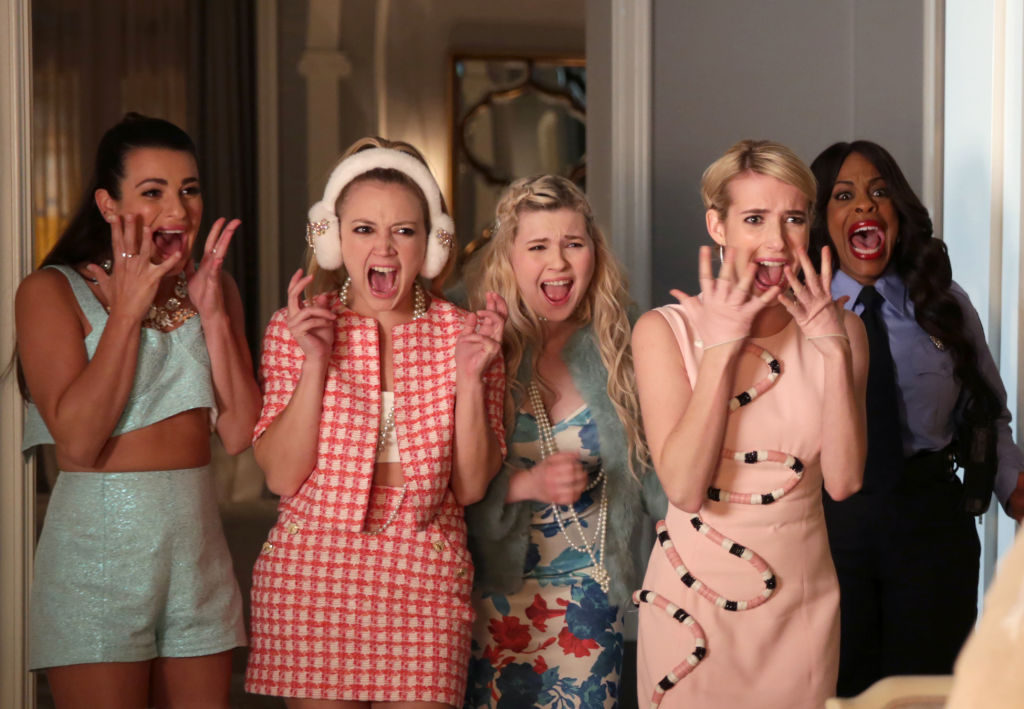
“Scream Queens” is a 2015 satirical dark comedy horror series centered on Chanel Oberlin, played by Emma Roberts, the ruthless Kappa House president who rules her sorority sisters with an iron fist as a chain of murders plagues campus Greek life. The series covers different topics with shock value turned up to 100. Plenty of messed-up stuff happens in this show and many outrageous factors that make it entertaining, but overall, it depicts an impossibly over-the-top version of university life.
For starters, the Kappa sisters live in a Kardashian mansion with walk-in closets and cryogenic freezers. Additionally, I’m sure sorority rushes get crazy, but I don’t think they usually involve gruesome murders and babies being born in bathtubs, even if real-life sororities or fraternities have been accused of some pretty horrible stuff. The show is also incredibly racist, sexist and classist. For instance, Chanel employs a personal “hired Asian” to take tests for her, uses a racial slur most famously used in “Gone with the Wind” to address her white maid and openly rejects “ethnics” from becoming pledges, to highlight just a few examples.
Extreme as these depictions are, they capture a hint of reality: Greek life has long grappled with historical racism and elitism tied to generational wealth or privilege. Overall, the show is pretty inaccurate and exaggerates a lot of things, making it feel like it’s in its own campy universe.
(On a side note, how did Lea Michele get a role where she has to read a script? I’m confused. Maybe someone fed the lines to her.)
First Daughter
The 2004 film “First Daughter” follows Katie Holmes as Samantha MacKenzie, daughter of the president of the United States, as she enrolls in college and forges a romantic relationship with a fellow student. Navigating university on her own for the first time, she endures many difficulties as a public figure through the highs and lows of college life.
The film stars singer-songwriter Amerie as a supporting character, renowned for her hit tracks like “Why Don’t We Fall in Love” and “1 Thing.” Regrettably, the film pigeonholes her into the stereotypical “sassy Black friend” archetype, a frustrating and demeaning categorization for a likeable off-screen actress. While the story addresses college events, activism and protesting, a recurring flaw is the ongoing issue with Katie Holmes’s character’s access to her dorm. Whenever she asks her roommate (Amerie’s character) to let her in, she is repeatedly locked out. In a real-world scenario, a student would likely report this to Residential Life, but instead it raises a basic question: why doesn’t she have her own set of keys to enter her room? While the portrayal of campus life isn’t drastically inaccurate, small oversights like these accumulate over time.
Legally Blonde
2001 cult classic “Legally Blonde” follows Elle Woods, played by Reese Witherspoon, on a mission to win back her boyfriend Warner, played by Matthew Davis, by getting into Harvard Law School. But in the end, her determination and intelligence propel her to new heights, going against what her peers expect of her. The movie’s a fun ride, but honestly? If you’re enrolling in Harvard Law just to win back an ex, you need more than a degree — you need therapy. Still, Elle Woods is iconic, and unlike most college movies, this one actually remembers that students are supposed to spend time in lecture halls. Elle’s classes don’t seem too inaccurate, and they don’t end after five seconds.
Ultimately, if you’re looking for a realistic portrayal of GPA stress, all-nighters and the nightmare of registration, you probably shouldn’t use Hollywood as a reference point. But if you want a caricature experience — whether it be campy, controversial and occasionally hilarious — these pieces of media hit the mark, even if they really aren’t about college at all.